





Creating a compelling e-commerce service is no longer just about offering competitive prices or a wide product assortment. Today’s retail customers expect fast, intuitive, and reassuring experiences across every interaction, from product discovery to delivery and after-sales support. When those expectations aren’t met, customers rarely complain. Instead, they leave.

To stand out in a crowded market, retailers must understand not only what customers buy, but how they experience the entire e-commerce journey. This requires moving beyond surface-level metrics and combining different types of customer feedback to uncover friction, improve service quality, and build long-term loyalty.
In this article, we explore how retailers can create a compelling e-commerce service by designing experiences around customer needs, capturing feedback at the right moments, and turning insight into action across teams.
Why e-commerce service quality is becoming a competitive necessity
E-commerce continues to claim a growing share of global retail sales, a trend that shows no sign of slowing. As the chart below illustrates, online sales are expected to account for an ever-larger proportion of total retail revenue over the coming years.
Behind this growth is a rapidly expanding global customer base. In 2024, an estimated 2.71 billion people worldwide shopped online, and that number is expected to rise sharply toward the end of the decade.
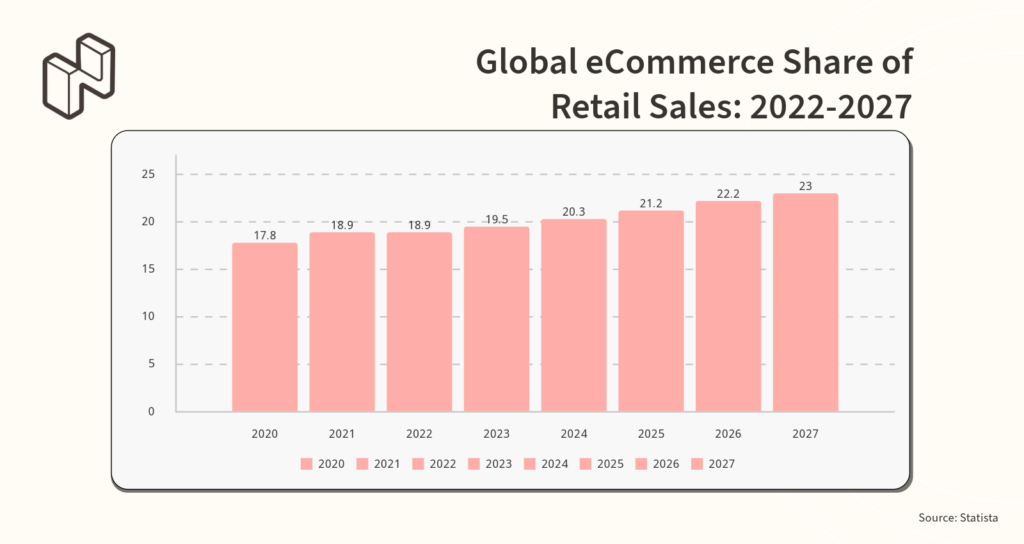
For retailers, this growth brings both opportunity and pressure. As online becomes the default channel, expectations are shaped by the best digital experiences customers encounter anywhere. Convenience, speed, clarity, and reliability are no longer differentiators, they are baseline requirements.
This makes e-commerce service quality a critical driver of conversion, retention, and long-term loyalty.
Understanding the modern e-commerce customer journey
The online customer journey is no longer linear. Customers move between devices, channels, and touchpoints, often researching extensively before making a decision. Key stages typically include:
- discovery and inspiration
- product research and comparison
- purchase and checkout
- delivery, returns, and after-sales service
- loyalty and advocacy
Each stage represents a moment where customers form impressions about your brand. Problems at any point can lead to hesitation, abandonment, or dissatisfaction, even if the product itself is strong.
Designing service around moments that matter
A compelling e-commerce service focuses on moments that have the greatest impact on customer perception. These moments often include product discovery, checkout, payment, and post-purchase communication.
Rather than measuring satisfaction only after the fact, leading retailers design service experiences that anticipate customer needs and reduce uncertainty before issues arise. This includes clear product information, transparent pricing and delivery details, and proactive communication throughout the order lifecycle.
Capturing customer feedback across the e-commerce journey
To improve e-commerce service, retailers need insight into how customers experience each stage of the journey. This requires capturing feedback in ways that reflect real customer behaviour and context.
Collecting feedback at the right time and place
Strategic feedback collection is not about asking more questions, but about asking them at the right moments and in the right channels. Feedback gathered immediately after key interactions, or during moments of friction, is more accurate and more actionable than feedback collected long after the experience.
Surveys are effective for understanding post-purchase satisfaction, service quality, and loyalty. Metrics such as CSAT or NPS help retailers track trends over time and identify customers at risk of churn. However, many e-commerce issues occur before a customer ever completes a purchase. Friction during product search, unclear content, checkout errors, or payment limitations often lead to silent abandonment. Capturing feedback directly within the digital journey helps retailers understand why customers hesitate or leave.
Onsite and in-app feedback tools make it possible to collect contextual sentiment at critical touchpoints, such as product pages, search results, or checkout flows. When combined with survey data, this creates a more complete view of the e-commerce service experience.
Turning feedback into actionable insight
Collecting feedback is only valuable if it leads to better decisions. Retailers must move from descriptive reporting to actionable insight.
This means identifying patterns in feedback, understanding which issues have the greatest impact on conversion or satisfaction, and prioritising improvements accordingly. Modern analysis techniques, including text and sentiment analysis, help teams process large volumes of qualitative feedback and uncover recurring themes.
By linking feedback to specific journey stages or customer segments, retailers can focus resources where they matter most, improving both efficiency and experience quality.
Aligning teams around e-commerce service improvement
E-commerce service is shaped by multiple teams, including marketing, UX, IT, operations, and customer support. To create a consistent experience, feedback insights must be shared across these functions.
When teams work from a shared understanding of customer needs, collaboration improves and action becomes faster. For example:
- UX and CRO teams can address usability issues highlighted by journey feedback
- product teams can improve content and functionality based on recurring customer questions
- support teams can proactively resolve issues before they escalate
- leadership teams can prioritise investments based on customer impact
Breaking down silos ensures that service improvements are coordinated rather than fragmented.
Closing the loop with customers
A compelling e-commerce service does not end with internal action. Customers also need to see that their feedback leads to change.
Closing the feedback loop involves following up with customers after negative experiences, communicating improvements, and reinforcing trust. Even small gestures, such as acknowledging feedback or explaining next steps, can significantly improve customer perception. Retailers that consistently close the loop demonstrate that they value customer input and are committed to continuous improvement.
Building a resilient and customer-focused e-commerce service
Creating a compelling e-commerce service is an ongoing process. Customer expectations evolve, technology changes, and new friction points emerge. Retailers that succeed are those that listen continuously, act decisively, and design service experiences around real customer needs.
By understanding the full e-commerce journey, capturing feedback at the moments that matter, and turning insight into coordinated action, retailers can deliver service experiences that not only convert, but retain and delight customers.
In a competitive retail landscape, great e-commerce service is no longer a differentiator. It is the foundation for sustainable growth.