




It has never been easier to collect customer feedback. Surveys, reviews, ratings, and comments flow in from every channel, often in real time. Yet for many organisations, customer feedback still ends up as reports, dashboards, or isolated metrics that rarely influence real decisions.
Positive NPS scores and glowing reviews can feel reassuring, but collecting feedback for validation alone does not create better customer experiences or stronger businesses. The real value of customer feedback lies in what you do with it. Especially negative feedback, often ignored or downplayed, is one of the richest sources of strategic insight a company has.

Bill Gates once said, “Your most unhappy customers are your greatest source of learning.” Customer feedback, especially negative ones, is an often untapped pool of learnings for business development. When you take a closer look at the data you collect, you can gain insights and build strategies to increase customer retention and grow your business.
In this article, we outline a practical framework for turning customer feedback into strategic opportunities. You’ll learn how to move from collecting opinions to driving decisions, aligning teams, and creating measurable business impact.
Why customer feedback is a strategic resource
Customer feedback reflects reality as customers experience it, not as organisations assume it to be. It reveals friction, unmet needs, and emotional drivers that are difficult to capture through internal metrics alone.
When used strategically, customer feedback helps organisations:
- understand what truly matters to customers
- identify risks to retention and loyalty early
- uncover opportunities for differentiation
- validate or challenge internal assumptions
The mistake many organisations make is treating feedback as a scorecard rather than a source of insight. Metrics like NPS, CSAT, or star ratings are useful signals, but they rarely explain why customers feel the way they do. Strategic value emerges when feedback is analysed, contextualised, and connected to action.
Start with a clear objective before collecting feedback
Before launching a new survey or feedback initiative, it is essential to be clear on what you want to achieve. Without a defined purpose, feedback programmes quickly generate noise instead of insight.
Key questions to clarify upfront include:
- What decisions should this feedback support?
- Which teams need to act on the insights?
- What business outcomes are we trying to influence, such as retention, growth, or efficiency?
When defining your objective, it is important to have a clear view of the entire customer journey. This includes understanding where customers interact with your brand, how those interactions affect their experience, how touchpoints connect across the journey from awareness to loyalty, what you measure and how often, and how customer feedback ultimately support better business decisions.
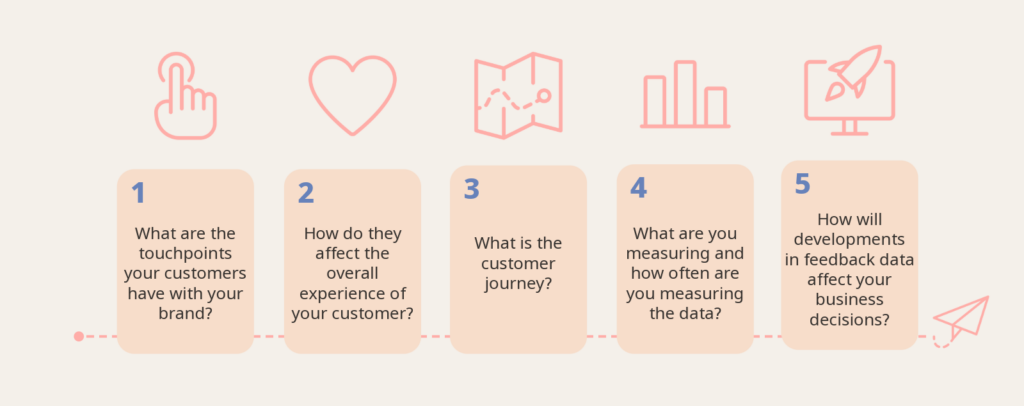
By starting with the end goal in mind, you can focus on collecting feedback that is relevant, timely, and actionable. This approach reduces the risk of analysis paralysis and ensures that insights can be translated into concrete next steps.
From feedback to insight: analysis that drives decisions
Before feedback can be analysed and turned into insight, it needs to be collected in a way that reflects real customer experiences. Strategic feedback collection is not about asking more questions, but about asking at the right moments and in the right places. Effective feedback strategies make it easy for customers to share their opinions, meet them in the channels they already use, and capture sentiment close to the experience itself. Timing plays a critical role here: feedback gathered immediately after key interactions, or during moments of friction, is more accurate, more actionable, and more likely to lead to meaningful improvement.
This is also where combining different feedback methods becomes valuable. While surveys are well suited for capturing structured input after interactions, in-the-moment feedback collected directly within digital journeys can surface issues before customers ever reach out to support. Onsite and in-app feedback tools make it possible to capture contextual sentiment at critical touchpoints and feed it into the same insight and action workflows as survey data.
When feedback collection is designed with timing, channel, and context in mind, analysis becomes more reliable and insights more relevant.
Want to explore how in-app and onsite feedback can complement surveys? Learn more about in-the-moment feedback solutions.
Turning customer feedback into action across the organisation
Customer feedback only becomes strategic when it influences decisions across teams. While CX or insights teams often own feedback programmes, the actions that drive impact typically sit elsewhere in the organisation.
Below are some of the most common areas where customer feedback creates strategic value. Each of these areas is explored in more depth in dedicated articles.
Product development and management
Customer feedback helps product teams understand where users struggle, which features create value, and which improvements will have the greatest impact. Analysing recurring themes and patterns allows teams to prioritise product changes based on real customer needs rather than internal opinions.
This includes using feedback to optimise existing features, identify and fix technical issues, and anticipate shifts in customer expectations or market demand.
Customer support, success, and experience
Support and success teams are closest to customer sentiment. Feedback highlights where processes break down, where communication fails, and where expectations are not met.
Used strategically, service feedback enables teams to personalise interactions, prioritise high-value customers, and proactively address issues before they escalate into churn.
Marketing and branding
Customer feedback offers a direct window into how a brand is perceived. Open-ended responses reveal the language customers use, the benefits they value, and the gaps between intended and actual brand positioning.
Marketing teams can use these insights to refine messaging, improve segmentation, and create campaigns that resonate more deeply with real customer needs and motivations.
Sales and retention
Feedback often signals churn risk long before it shows up in revenue numbers. By identifying dissatisfied or disengaged customers early, sales and account teams can intervene proactively. Customer feedback also highlights what customers genuinely value, helping sales teams sharpen value propositions, tailor conversations, and activate satisfied customers as advocates.
Leadership and management
At a strategic level, customer feedback provides leadership teams with an unfiltered view of organisational performance from the customer’s perspective. When shared transparently across teams, feedback supports better prioritisation, breaks down silos, and aligns decision-making around customer outcomes rather than internal metrics alone.
Closing the customer feedback loop
Collecting and acting on feedback is not enough on its own. Customers also need to see that their input leads to change.
Closing the customer feedback loop means communicating back to customers what has been done as a result of their feedback. This can include following up after a negative experience, sharing product improvements, or acknowledging suggestions that influenced decisions. Internally, closing the loop also requires clear ownership. Teams need defined responsibilities for responding to feedback, tracking actions, and measuring impact. Without this structure, even well-intentioned initiatives lose momentum.
Building a feedback-driven culture
For customer feedback to become a strategic asset, it must be embedded in how the organisation works. This involves:
- making feedback accessible across teams
- encouraging collaboration around customer insights
- investing in skills and tools to analyse and act on data
- reinforcing the idea that negative feedback is an opportunity to improve
A feedback-driven culture shifts the focus from defending scores to learning and improvement. Over time, this mindset strengthens both customer experience and business performance.
Turning insight into long-term impact
Customer feedback has the potential to shape strategy, guide innovation, and strengthen relationships. But this potential is only realised when feedback is treated as a starting point, not an end result.
By starting with clear objectives, analysing feedback for insight, acting across teams, and closing the feedback loop, organisations can turn customer input into strategic opportunities. The companies that succeed are not those that collect the most feedback, but those that listen with intent and act with purpose.